
Helping Children Settle Into a New Home sounds straightforward enough on paper, but in reality, it’s often messy, emotional, and full of unexpected challenges. When my two daughters and I moved to Germany, we weren’t just moving house—we were starting over after our family had fallen apart. It was a huge change for all of us.
“Home isn’t always a place—sometimes it’s the people who make you feel safe.”
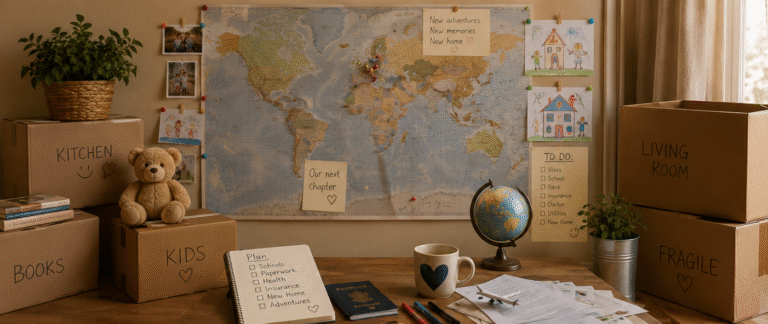
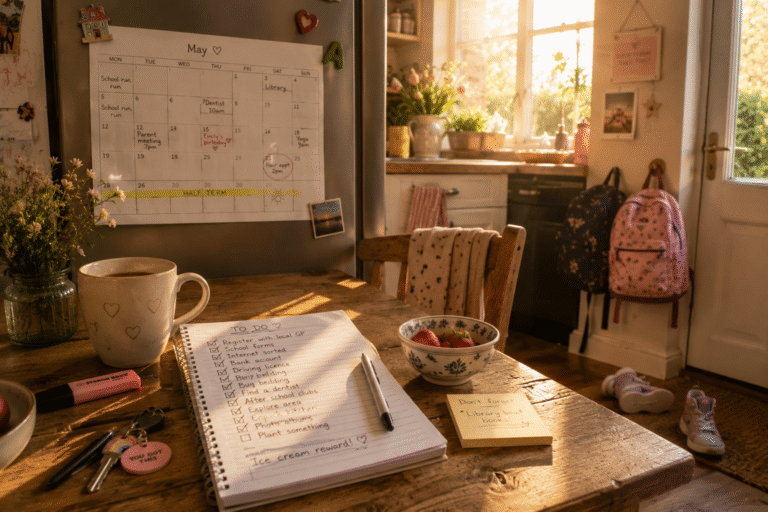
Determined to make the transition as smooth as possible, I approached the move with military precision. There were lists, schedules, paperwork folders, school registrations, and enough planning to rival a small government project. During the school holidays, things seemed to be going surprisingly well. We explored new places, settled into our home, and enjoyed the excitement of a fresh start.
Then real life arrived.
School began, language barriers became more noticeable, homesickness crept in, and the first cracks started to appear. There were tears over missing friends, frustrations over not understanding everything, and moments when all three of us felt completely overwhelmed.
To help put things into perspective, we invented an ice-cream scoring system. A small problem was worth one scoop of ice cream—a little hiccup that would probably sort itself out. Bigger issues earned two or three scoops. But the really tough days? Those were full-cup-of-ice-cream situations that required everyone to sit down, talk it through, and sometimes just admit that things felt hard.
Looking back, it wasn’t the big plans that helped us adjust. It was the small routines, little comforts, and simple coping tricks that made helping children settle into a new home feel just a little easier, one scoop at a time.
Why Big Moves Can Be Difficult for Children
Children Process Moving Differently Than Adults
While I was knee-deep in school registrations, rental agreements, and trying to remember which box contained the kettle, my daughters had far more time to think. Like most adults facing a big move, I was busy with forms, packing, planning, and a seemingly endless list of things that needed sorting. Looking back, I suspect that busyness was doing me a favour. It left very little room to dwell on my own fears and uncertainties.
The truth is that I wasn’t all that different from the girls. I worried about whether we’d settle, whether we’d be happy, whether I was making the right decision, and what our future would look like. The difference was that I had tasks to distract me. My daughters didn’t. The move was something that had been decided for them, not by them, and unlike me they couldn’t bury their worries under a mountain of paperwork.
Research suggests that this is a common experience. Children have very little control over major life changes, yet they are expected to live with the consequences of them. While adults can focus on the practicalities, children are often left with more time to think about what they are losing—friends, familiar places, routines, and the comfort of knowing exactly what tomorrow will look like.
It took me a while to realise that while I was busy managing the move itself, the girls were busy trying to make sense of it.
Leaving Familiar People and Places Can Feel Like Grief
If you’ve ever moved house, you’ll probably understand this feeling. We often think of grief as something that happens when we lose a person. However, it can also appear when we lose places, routines, and the little things that make life feel familiar.
The girls were grieving friendships, favourite places, and the comfort of knowing exactly where they belonged. Meanwhile, I was grieving too.
I’ve always been a creature of habit. I like knowing where things are. I like familiar shops, familiar roads, and familiar routines. In fact, there is a surprising amount of comfort in knowing where to go when you need something. You don’t realise how much you rely on that until it’s gone.
Suddenly, everything felt new – from school, over doctors to roads. Even a new language. As a result, simple tasks often felt much harder than they should have.
Research suggests that major moves can trigger feelings similar to grief because they involve the loss of familiar people, places, and routines. Looking back, that makes perfect sense. We weren’t just moving to a new home. We were letting go of an old life.
For the girls, that grief sometimes appeared as tears over small things. For me, it was often a longing for the familiar. Not because our old life was perfect, but because it was known.
And when everything feels uncertain, there is something incredibly comforting about knowing exactly where the kettle lives.
That was also when our ice-cream scoring system came into its own. Some worries were only worth one scoop. Others needed a full sit-down cup of ice cream and a proper chat. Sometimes simply acknowledging that something felt hard made it a little easier to carry.
The Signs Were There, Even When Nobody Was Saying Much
Research shows that children don’t always tell us when they’re struggling. More often, they show us through their behaviour. Signs to watch for include:
- Becoming more clingy than usual
- More tears or emotional outbursts
- Anger and irritability
- Sleep problems
- Tummy aches or headaches
- Not wanting to go to school
- Withdrawal from friends or activities
- Loss of confidence
- Increased worrying
My girls showed their feelings in very different ways.
For a while, Faye became a bit like Velcro. She wanted to be close to me all the time. She also didn’t want to go to school. There were plenty of tears and a few angry outbursts too.
Ruby was different. Sometimes she became mean or cruel towards her sister. When I asked what was wrong, she often couldn’t tell me. Then, after a bit of gentle persistence, the tears would come.
Looking back, she was like a pressure cooker. She kept everything inside until there was simply too much steam. Then it all came out at once.
The hardest part for me was not taking it personally. Over time, I realised the girls weren’t angry with me. They were trying to cope with feelings they didn’t yet have the words to explain.
New Schools, New Languages, and New Friendships Add Extra Pressure
Research shows that social connections are one of the biggest factors in helping children adjust after a move. Changing school is way up there with one of the stressiest things for a child.
Unfortunately, making friends isn’t always easy. A new school brings new routines, new faces, and new expectations. Add a new language into the mix, and the challenge becomes even bigger.
My girls approached this in completely different ways.
Ruby was excited from the start. She made friends quickly and threw herself into new experiences. Being a little older helped. So did the fact that many children in her class already knew some English. Ruby isn’t much of a worrier either. She never seemed overly concerned about what other people thought of her.
Faye, on the other hand, is her complete opposite.
For her, not speaking German felt like a huge wall. Every interaction became harder. When children looked at her because she was the new girl, she often assumed they were judging her. In her mind, they weren’t curious. They probably just didn’t like the colour of her T-shirt.
As adults, we can smile at that thought. However, when you’re young, nervous, and unable to understand the conversations around you, it’s easy to assume the worst.
Thankfully, confidence grows with familiarity. A few German words became sentences. Familiar faces became friends. And little by little, that wall started to come down.
What Worked: Strategies That Helped my Children Settle In
There wasn’t one magic solution that suddenly made everything easier. Instead, it was lots of small things that slowly helped the girls feel more settled. Some of the things that worked for us included:
- Creating simple daily routines
- Celebrating small wins
- Talking about feelings without forcing it
- Exploring our new surroundings together
- Making new memories while keeping old traditions
- Giving the girls time to adjust
- Focusing on progress rather than perfection
- Encouraging friendships and social activities
The first thing I tried to do was establish routines. After all, when everything feels new, a little predictability goes a long way. Mornings and evenings were the easiest place to start. Breakfast happened at the same time. Bedtime followed the same pattern. They were small anchors in a sea of change.
Talking about feelings was a little trickier. More often than not, it happened after a massive argument. Looking back, it was a bit like a summer thunderstorm. You could almost feel the air getting heavier before everything finally burst. Once the tears, frustration, and angry words were out, we could usually talk about what was really bothering them.
I also made a point of getting out and exploring. At first, we walked everywhere. Later, we took the bikes. Along the way, I showed the girls landmarks and the little shortcuts I remembered from my own childhood. Before long, unfamiliar streets started to feel familiar.
And then there was the ice cream.
We celebrated everything. A good day at school. A new German word. A successful playdate. A brave moment. Some weeks I was fairly sure we were single-handedly keeping the local ice-cream shop in business. But those little celebrations mattered. They reminded the girls that progress doesn’t happen all at once. It happens one small victory at a time.
What Didn’t Work: Mistakes and Lessons Learned
Not everything we tried was a success. In fact, some of my best intentions made things harder.
Here are a few things that didn’t work for us:
- Keeping the girls too busy
- Trying to solve every problem immediately
- Expecting adjustment to happen quickly
- Assuming what worked for one child would work for the other
- Comparing progress
At first, I tried to cope with the move the same way I usually cope with stress. I kept busy. Very busy.
So, I signed the girls up for activities. Then we visited friends and family. If there was a gap in the calendar, I filled it.
At the time, I thought I was helping. However, all I really did was leave them with very little time to process everything that had happened.
Eventually, it all came out during one spectacular argument. The girls were exhausted. More importantly, they felt overwhelmed and completely without a say in any of it.
After that, we cut right back.
Looking back, it makes perfect sense. The move had already taken away so much control. Meanwhile, I was accidentally taking away even more by planning every spare moment.
Interestingly, I never compared the girls. However, Faye compared herself to Ruby all the time. Ruby settled quickly. She made friends easily and seemed to take everything in her stride. Faye struggled more, and she noticed it.
As a result, she started to think there must be something wrong with her. Of course, there wasn’t.
They were simply different children facing the same challenge in different ways. Once I understood that, things became much easier for all of us.
Navigating Language Barriers
Of all the challenges we faced after moving to Germany, the language barrier was probably the biggest. It affected almost every part of daily life, from making friends to understanding school lessons and even simple things like ordering an ice cream.
What I quickly realised was that there were really two sides to the language challenge: the emotional side and the practical side.
The Emotional Side of Learning a New Language
When adults move abroad, we expect language difficulties. Children, however, often expect to fit in quickly, which can make the reality particularly hard.
Not understanding what is happening around you can feel incredibly isolating. Imagine sitting in a classroom and not fully understanding your teacher. Or hearing your friends laugh at a joke and having no idea why everyone else finds it funny.
For children, language is about much more than communication. It is how they build friendships, join games, ask for help, and express who they are. When those words suddenly disappear, it can knock their confidence.
There were times when the girls came home frustrated or upset because they couldn’t quite keep up with conversations. Sometimes they worried about saying the wrong thing. Other times they simply felt left out.
What helped most was reminding them that understanding takes time. Every new word learned was progress, even if it didn’t always feel like it.
The Practical Side of Learning a New Language
While the emotional side needed patience, the practical side needed consistency.
Rather than trying to learn everything at once, I started with nouns and frequently used words. Everyday objects were often the easiest place to begin because the girls encountered them constantly.
Faye needed extra reading practice, so we started reading simple German books together. She would read a sentence in German, and then I would translate it into English. What should have been a ten-minute reading exercise often became a twenty-minute one, but it was time well spent.
We also immersed ourselves in the language as much as possible. The television was in German, and I often had a German radio station playing in the background at home. Even when the girls weren’t actively listening, they were becoming familiar with the sounds, rhythm, and patterns of the language.
Games and apps helped too because they made learning feel less like schoolwork and more like fun.
Some of the resources that worked well for us included:
Board Games
- Scrabble Junior (using German vocabulary)
- Dobble (Spot It!) – great for learning object names quickly
- Bananagrams – simple, fast-paced word building
Apps
Most importantly, we tried to make German part of everyday life rather than something that only happened during lessons. Little by little, the words started to stick, and eventually the girls began to realise they understood far more than they thought they did.
Helping Children Build New Friendships
One of the questions I worried about most before moving was whether the girls would make friends.
As parents, we know how important friendships are to children. Friends help them feel settled, confident, and like they belong. When you’ve just moved to a new country, those friendships can feel even more important.
What I learned, however, was that helping children make friends has both a practical side and an emotional side.
Creating Opportunities for Friendships
Friendships rarely happen if children never get the chance to meet other children.
With that in mind, I focused on creating opportunities. I signed the girls up for sports clubs, holiday activities, and local events whenever I could. We also met up with friends who had children of a similar age.
At first, it sometimes felt like hard work. The girls didn’t always want to go, and there were occasions when they came home feeling disappointed. However, every activity gave them another chance to meet people and become more familiar with their new surroundings.
Over time, those small opportunities started to add up. Familiar faces became acquaintances, acquaintances became friends, and little by little they began to build their own lives here.
Learning to Handle Rejection
Making friends is important, but learning that not everyone will want to be your friend is important too.
This was probably one of the harder lessons, particularly because rejection can feel much bigger when you already feel different or out of place.
There were times when children didn’t want to play, invitations weren’t returned, or friendships simply didn’t develop the way the girls had hoped. Naturally, that hurt.
I had many conversations with Faye about this. Often, I would ask her whether she would actually have been friends with some of those children if we had still been living in Ireland.
The answer was usually no.
Sometimes, when children move abroad, they can assume every disappointment is connected to the move. In reality, some experiences are simply part of growing up. Children get left out. Friendships change. Personalities clash. Those things happen everywhere.
That doesn’t make the hurt any less real, but it can help to put it into perspective.
Over time, I wanted the girls to understand that being liked by everyone was never the goal. Finding people who genuinely liked them for who they were was far more important.
And thankfully, those people did come along.
Supporting Children’s Emotional Wellbeing During the Transition
Moving abroad is exciting, but it is also a major life change. While adults often focus on practical matters such as housing, schools, and paperwork, children are usually trying to make sense of something much bigger: how they feel about it all.
Every child processes change differently. Some seem to settle immediately, while others struggle quietly beneath the surface. That is why emotional wellbeing deserves as much attention as any practical aspect of the move.
Recognising When Your Child Is Struggling
One of the hardest parts of supporting children emotionally is that they do not always tell us what is wrong.
Sometimes their feelings appear as tears, anger, clinginess, or frustration. Other times, they show up in less obvious ways. A child who is unusually quiet, tired, withdrawn, or argumentative may be struggling more than they can express.
I learned that it was important to look beyond the behaviour and ask what might be causing it.
Were they missing friends? Feeling overwhelmed at school? Worried about fitting in? Frustrated by the language barrier?
Often, the behaviour wasn’t the problem. It was simply the symptom of something bigger.
Why Emotional Wellbeing Matters So Much
When children feel emotionally secure, they are far better equipped to handle all the other challenges that come with moving abroad.
Learning a new language, making friends, adapting to a new school, and building confidence all require emotional energy. If a child is feeling anxious, lonely, or unsettled, those challenges can feel much bigger.
What I gradually realised was that helping the girls feel safe, heard, and understood was often more important than solving the problem itself.
Sometimes they didn’t need answers. They simply needed someone to acknowledge that what they were experiencing was difficult.
Children do not always remember the advice we give them, but they do remember how supported they felt during hard times.
Practical Ways to Support Emotional Wellbeing
For us, emotional wellbeing wasn’t about grand gestures. It was usually the small things that made the biggest difference.
Talking openly about feelings became important. Sometimes that meant having a conversation at bedtime. Other times it happened unexpectedly in the car or while walking home from school.
We also tried to keep some familiar routines from Ireland. In the middle of so much change, familiar habits provided a sense of comfort and stability.
Most importantly, I tried not to rush difficult emotions away. When the girls felt sad, frustrated, homesick, or angry, I learned to sit with those feelings rather than immediately trying to fix them.
We also made time for things that simply made them happy. Playing outside, spending time with friends, pursuing hobbies, celebrating small achievements, and exploring our new home all helped build positive experiences alongside the difficult ones.
Looking back, emotional wellbeing wasn’t something separate from the move. It was woven through every part of it. The more supported the girls felt emotionally, the easier it became for them to adapt, grow, and eventually feel at home in Germany.
The Surprising Benefits of Moving Abroad as a Child
If you’ve read this far, you might be wondering whether moving abroad with children is worth all the challenges.
For us, the answer is yes.
That doesn’t mean it was easy. There were tears, frustrations, setbacks, and moments when I questioned whether I had made the right decision. However, there were also rewards that I could never have imagined when we first packed our bags.
Greater Confidence and Independence
One of the biggest changes I have seen in the girls is their confidence.
They have had to navigate a new country, a new school system, a new language, and entirely new social circles. Along the way, they learned that they could cope with difficult situations and come out the other side.
That confidence didn’t appear overnight, but it grew with every challenge they overcame.
Learning a New Language and Culture
The obvious benefit is that the girls are becoming bilingual, but the advantages go far beyond language.
They have been exposed to a different culture, different traditions, and different ways of doing things. They are learning that there is more than one way to live, celebrate, learn, and connect with people.
I hope that experience will help them become open-minded, adaptable, and curious about the world around them.
A Wider View of the World
Moving abroad has shown the girls that home can be more than one place.
They still have strong connections to Ireland, but they are also building a life in Germany. As a result, they have developed a broader understanding of people, places, and experiences than they might otherwise have had.
I often think that one of the greatest gifts we can give children is the confidence to step outside their comfort zone and discover that the world is much bigger than they imagined.
Stronger Than We Realised
Perhaps the greatest lesson wasn’t what the girls learned about Germany. It was what they learned about themselves.
They discovered that they could make new friends, learn a new language and adapt to change. They could start over when life took an unexpected turn.
And if I’m honest, I learned exactly the same thing.
Looking back now, I don’t remember every difficult day. What I remember is watching the girls grow into resilient, capable young people and realising that this move gave all of us opportunities we would never have had if we had stayed where we were.
Moving abroad wasn’t always easy, but it has been one of the most rewarding adventures our family has ever taken.
Conclusion
Helping children adjust after a big move is rarely a straight path. There will be wonderful moments alongside difficult ones. Some strategies will work immediately, while others may not help at all. What matters most is providing consistency, patience, and reassurance as children navigate unfamiliar surroundings, language barriers, and new friendships.
Looking back, the biggest lesson I learned was that adjustment can’t be rushed. Children need time to grieve what they’ve left behind while slowly building a sense of belonging in their new home. With support, understanding, and plenty of encouragement, what initially feels overwhelming can eventually become an experience that strengthens confidence, resilience, and family bonds.