What if home isn’t a place at all?
For years, people asked me why I chose Ireland over Germany. My usual answer was, “I certainly didn’t leave Germany because of the countryside.” That normally got a laugh.
The truth, however, was always a bit more complicated.
I left Germany when I was twenty in search of adventure. Or freedom. Or maybe just because at twenty, moving to another country seemed like a perfectly sensible thing to do.
The funny thing is that although I moved to Ireland, I didn’t actually decide to stay there for years. Looking back, my emigration was less a carefully thought-out life choice and more a twenty-five-year experiment that somehow got out of hand.
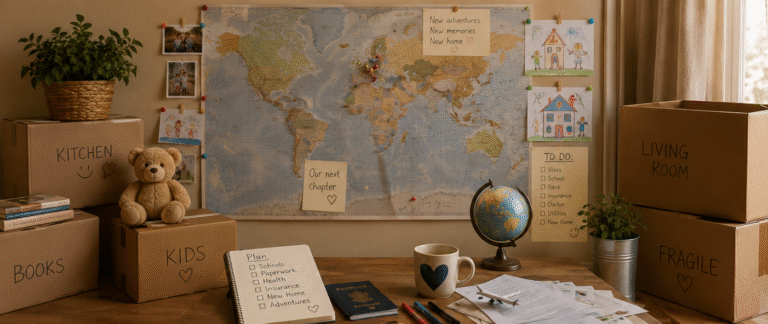
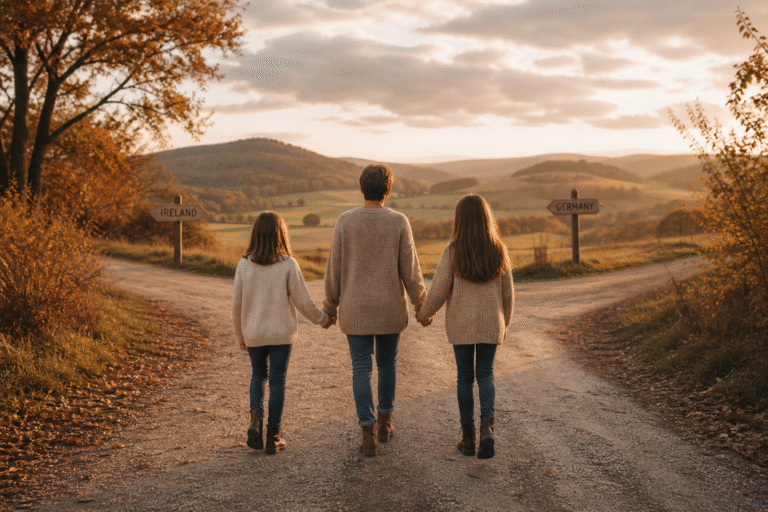
Then last year, I packed up my life once again and moved back to Germany with my two daughters as life took an unexpected and not so nice turn.
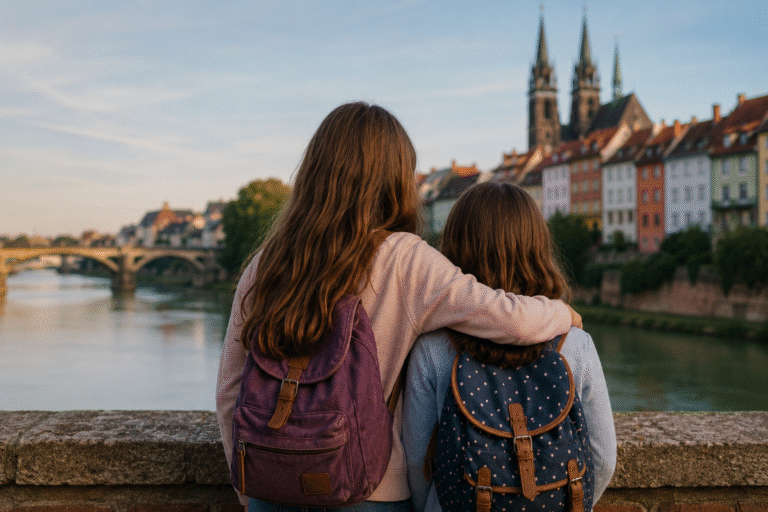
You would think that returning to the country where I grew up would feel like coming home. Instead, it left me wondering whether home had ever been a country in the first place.
Because the longer I live, the more I suspect that what I was searching for wasn’t a certain patch of land, but a feeling. A sense of belonging. Community. Connection. The kind of people who notice when you’re missing and are happy to see you when you come back.
This is the story of leaving Germany, building a life in Ireland, and discovering that the longest journey wasn’t between two countries at all. It was figuring out who I am and what I want.
Why I Left Germany
The funny thing is that I didn’t really leave Germany for the first couple of years. Not in the dramatic, packing my life into boxes and relocating kind of way.
I simply went to Ireland and kept extending the working holiday. For years, there was no grand decision to stay. One year became two. Two became five. Somewhere along the way, a temporary adventure quietly turned into a life.
Looking back, the search was never really for a different country. It was for a place that felt like home.
Germany often felt like a cage that was just a little too small for my wingspan. Not because there was anything wrong with it, but because there never seemed to be quite enough room to stretch.
Which makes very little sense when you think about it as Germany has more choices, more opportunities, more shops, more activities and more of just about everything. Yet Ireland somehow felt bigger.
Maybe because life felt simpler.
The people seemed less concerned with doing everything perfectly right and were more willing to figure things out as they went along. They seemed more flexible, spontaneous and more likely to laugh when things didn’t go according to plan.
In Ireland people just landed on your doorstep for a ‘cuppa’ (a cup of tea) which might end in dinner and drinks after.
A German coffee can occasionally feel like it requires a scheduling app and three weeks’ notice.
I am exaggerating, of course…. Although perhaps not by much.
What Ireland offered wasn’t more opportunity. It offered more breathing space. More room to try things, get things wrong and laugh about.
At least, that was how it felt at twenty.
The Kelly Family and the Search for Belonging
When I was a teenager, I became slightly obsessed with the The Kelly Family. Yes, there may have been a crush involved—I’ll spare everyone the details—but it wasn’t really about the music.
It was about what they represented.
A big, noisy family where life seemed to happen around one table. People talking over each other, teasing each other, laughing until someone snorted tea through their nose. The sort of family where it looked like anything was possible.
That was a world away from my own experience.
The best example is probably Christmas. My dad was an only child, my mum’s family was fractured, and yet somehow Christmas still involved enough driving to qualify as a small road trip. We had Christmas at our house, then visited two more. After my parents separated, the logistics became even more impressive. Looking back, it felt less like a family celebration and more like an endurance event with snacks.
There were years when I didn’t come home at all, simply because I couldn’t face another Christmas marathon.
Maybe that’s why the Kelly Family resonated so much. Not because I wanted a perfect family, but because I wanted everyone in the same room.
In hindsight, I sometimes wonder if it’s a coincidence that I eventually ended up in Ireland. The Kellys carried their Irish heritage proudly, and somewhere along the way I found myself drawn to it too. Whether it was fate, influence, or just a teenager searching for somewhere she belonged, I can’t say.
But looking back now, perhaps I was already following my own long way home.
Germans, Irish People and Road Closures
During my waitressing days, I often told a story that, in my mind, perfectly explained the difference between Germans and Irish people.
Imagine you’re driving along when you suddenly come across a road closure.
The German reaction is immediate.
Why wasn’t there a sign further back? How come there’s no diversion? Why has nobody planned this properly? The schedule is ruined, appointments will be late, and there is a very real chance the annoyance will last longer than the roadworks themselves.
The Irish reaction is completely different.
A road closure isn’t a problem. It’s a challenge.
“Is it really closed?”
“How far up?”
“Sure, let’s just have a look.”
An Irish person will happily continue as far as possible before admitting defeat. There is an almost admirable belief that there must be a way around the problem if you just keep going long enough.
Of course, it’s a stereotype, but like most stereotypes, it contains a grain of truth.
The German trusts the system.
The Irish trust themselves to figure it out.
For years, I felt much more at home with the Irish approach. Life seemed lighter when every inconvenience wasn’t treated as a personal attack from the universe. Problems weren’t always problems. Sometimes they were just stories waiting to happen.
Germany builds excellent systems.
Ireland produces people who genuinely believe almost any crisis can be solved with a roll of duct tape, a cup of tea, and a neighbour who knows a guy.
After moving back, I’ve realised both countries are far more alike than I once thought. But whenever someone asks me about the difference between Germans and Irish people, I still think of that road closure.
One nation sees a problem.
The other sees an adventure.
And somewhere between the two is probably where I belong.
Finding Community in Ireland
When I moved to Ireland, I found pieces of that.
At first, I belonged to the foreigners. There is a strange comfort in being lost together. We all came from somewhere else and missed things from home. The language was hard to adapt to for all of us. We all looked out for one another.
Maybe that’s one of the reasons I never fully committed to staying in Ireland for such a long time.
As long as I was a foreigner, I belonged to the foreigners.
Deciding to stay felt strangely final.
Eventually, though, Ireland stopped being temporary.
I became part of the local community, made friends who stayed all year. I built a life. Staying became a choice.
And for many years, I felt less lonely than I ever had before.
Returning to Germany After 25 Years
Returning was never part of the plan.
If I’m honest, Germany felt a bit like an old jumper I couldn’t get rid of so I shoved to the back of the cupboard years ago. Familiar, yes. Comfortable, maybe. But not something I ever expected to wear again.
Had life gone differently, I probably wouldn’t have returned. I certainly wouldn’t have pictured myself working in sales.
Yet here I am.
The move wasn’t really about Germany. It was about the girls. They needed stability, support and family around them, and Germany offered all three.
What surprised me most was how much Ireland had shaped me. After 25 years, I’d grown used to a culture where people make an effort. You stop for a chat and ask someone in for a cup of tea. The Irish create their belonging and are very active in connecting to people.
Ireland taught me that community doesn’t appear by magic. People build it, one conversation, one favour and one cup of tea at a time.
Returning also showed me how much I’d changed. I reconnected with old friends and found plenty of familiar faces, but twenty-five years leaves its mark on everyone. Alongside the comfort sat a little awkwardness as we tried to fit decades of life into a single conversation.
For a while, I wondered whether I would ever feel truly at home again.
Maybe home isn’t a place at all.
Maybe home is knowing who you are, what matters to you and how you want to live. Once you figure that out, the postcode matters a lot less.
And for the first time in a very long time, I feel like I’m heading in the right direction.
Rebuilding my life
‘ve never been particularly good at deciding what I like.
Years ago, a friend made me do one of those magazine personality tests. After studying the results for far too long, she looked up and declared:
“I think there must be more than one person living in your body.”
She may have had a point.
My career path certainly suggests she was onto something. I’ve led guided horse treks, tattooed people, made clothes, waitressed, run my own business and somehow ended up as a vegetable farmer.
The farming especially seemed to come completely out of nowhere for most people.
But then again, doesn’t every vegetable patch need a tattooed fashionista who can mix a decent cocktail while riding a horse?
The problem was never that I didn’t know what I liked. The problem was that I liked far too many things.
Before everything changed, I had built a life I loved. The farm, the plants, my family and my friends filled my days with purpose and joy.
Then the ground shifted beneath my feet, and I had to leave it behind.
Losing so much hurt, but it also forced me to stop and ask a question I’d avoided for years:
What actually makes me happy?
So I started paying attention.
I love creating things. Growing things. Learning things. Sharing food, stories and laughter with people I care about.
Once I understood that, rebuilding my life became a little easier. I didn’t need to recreate what I’d lost. I needed to take the pieces that mattered most and build something new around them.
Maybe that’s what I’ve learned on the long way home.
You don’t find yourself by choosing one version of who you are.
You find yourself by making room for all the wonderfully contradictory ones instead.
Maybe Home Isn’t a Place
Looking back, I think I’ve spent most of my life searching for home.
As a teenager, I looked for it in the noisy, carefree world of the Kelly Family. Later, I thought I’d found it in Ireland.
For years, life there felt exactly as I imagined home should feel. I had the farm, the plants, my family, my friends and a community around me. I stopped searching because I thought I had finally arrived.
Then the dynamic shifted.
The place that had once felt safe and familiar became a minefield, and I realised I couldn’t pack that version of home into a suitcase and take it with me.
Leaving forced me to ask a question I had never really considered before:
What actually makes a home?
For years, I thought the answer was a place. The right country, a great community and beautiful surroundings.
Now I think the answer is much simpler.
If your sense of home depends entirely on what surrounds you, a small change can take it away. Relationships fall apart, people move and our interests change.
But if you know who you are, what you love and what truly makes you happy, you can take those things anywhere.
The country may change and the people around you may speak a different language. The view from your kitchen window may change.
But curiosity, creativity, laughter, nature and meaningful connections travel with you.
Maybe that’s the lesson hidden in the long way home.
Home isn’t a place you find – its a place that lives inside of you.
It’s something you build.
And once you know what it’s made of, nobody can take it away from you.