When people talk about moving abroad with kids, they often focus on the exciting parts. The fresh start. The adventure. The idea of building a new life somewhere different. And yes, there is excitement in it — but wow, there’s also paperwork. Endless paperwork.
When we moved from Ireland to Germany, I thought I had prepared fairly well. I had researched schools, packed documents, arranged accommodation, and mentally prepared myself for the emotional side of starting over. What I hadn’t prepared for was just how many small details Google never really warns you about.
Germany, honestly, runs on paperwork. Forms for forms. Appointments to get appointments. Things needing stamps, copies, and documents you didn’t even know existed. Even though I had been born in Germany, I had left as a a young adult myself, so navigating the official side of life here felt completely unfamiliar. In many ways, I was starting from scratch alongside my children.
One of my biggest mistakes was assuming I understood how the school system worked. We moved in July, and because my girls had already finished the school year in Ireland, I naturally assumed they’d simply stay on summer holidays until the German school year began in September. Wrong. Very wrong.
That experience taught me something important very quickly: never assume you know how things work when moving abroad. Every country has its own systems, rules, timelines, and expectations. The more questions you ask before leaving, the easier those first few months will feel later on.
Important Paperwork To Organize Before Moving Abroad With Kids
Basic Identification Documents
I cannot stress this enough — organise your documents earlier than you think you need to. Germany especially has a way of humbling you very quickly when it comes to paperwork.
Of course, passports are obvious. You literally cannot move countries without them. But what I didn’t fully realise is how important identification becomes once you actually arrive. In Germany, adults are expected to have valid ID available, and nearly every appointment seems to involve proving who you are several times over.
I naturally always carry my driving licence, but I used to have a German Personalausweis and simply hadn’t gotten around to replacing it yet. That quickly became a priority after arriving. Even for children, having proper identification documents sorted early makes life much easier when dealing with schools, registrations, health insurance, and official appointments.
Health Insurance & Vaccination Records
One thing I really wish I had understood properly before moving to Germany was health insurance. I had done a lot of research before leaving Ireland, but this was still the one thing that caught me off guard.
We moved in July, and my job didn’t start until September. So I assumed we would just settle in first and that insurance would naturally start once I began working. However, that’s not how it works here. In Germany, health insurance is mandatory from the moment you register, which meant I had to sort out temporary private insurance right away.
That period was more expensive than I expected. Between deposits, setting up a home, school costs, and general living expenses, the added insurance payments made those first months feel financially tight. It all adds up very quickly when you’re starting from scratch in a new country.
At one point, I looked into Bürgergeld just to bridge the gap until my job started. But because my savings were above the threshold, I didn’t qualify. What I didn’t fully understand then is how complicated EU systems can be when you move between countries. Things like insurance history, contribution records, and residency rules all come into play, and none of it is clearly explained before you arrive.
So my advice is simple: don’t assume anything. Check your temporary insurance options before you move, and bring copies of your tax and social insurance records with you.
Also, don’t forget vaccination records for children. Schools in Germany require an up-to-date Impfpass, and proof of the measles vaccination is mandatory before attendance. Having everything ready beforehand saves a lot of stress later.
My Biggest Advice? Never Assume Anything
If moving to Germany taught me anything, it’s this: never assume you understand how another country’s systems work.
I assumed the girls would simply stay on summer holidays after finishing school in Ireland. Wrong.
I assumed health insurance could wait until my job started. Wrong again.
Every country has different rules, timelines, expectations, and bureaucracy. The more questions you ask before leaving, the easier those first few months abroad will feel.
Quick Paperwork Checklist Before Moving Abroad
Identification
- Passports
- Birth certificates
- Driver’s licence
- ID cards / Personalausweis
Health
- Vaccination passports
- Measles vaccination proof
- Health insurance documents
- Prescription copies
School
- School reports
- Registration documents
- Emergency contact details
Work & Finance
- Employment Detail Summary
- PRSI/social insurance contribution records
- Payslips and contracts
- Tax documents
Organisation
- Physical copies of important documents
- Digital backups
- Translated copies where needed
Research the School System Before You Arrive
Understanding the School System
Before moving to Germany, I would strongly recommend researching the school system in your specific Bundesland rather than Germany as a whole. Every state handles things slightly differently.
Here in Bavaria, children attend Grundschule until 4th grade. After that, they move into different school types such as Mittelschule, Realschule/Wirtschaftsschule, or Gymnasium. In other regions, primary school can continue until 6th grade, and some systems are more flexible.
If your children do not yet speak German, it is also important to ask about DAZ classes (“Deutsch als Zweitsprache” — German as a second language). Some schools are far better equipped for this than others. Certain schools have dedicated language support classes, while others may expect children to integrate directly into regular lessons much faster.
Looking back now, this is something I wish I had known beforehand because it can make a huge difference to how settled and supported your child feels during those first months.
Contact the School Before You Move
This is probably the biggest piece of advice I can give.
Do not rely only on Google. Contact the local school closest to where you plan on living before you move — especially if your child will attend Grundschule or Mittelschule.
Schools can tell you:
- what paperwork is required,
- whether DAZ support is available,
- which school type may suit your child best,
- and whether documents need to be officially translated.
This last point caught me off guard as well. Some schools may ask for translated school reports, birth certificates, or previous educational records so they can properly assess where your child fits into the system. Trying to organise official translations after arriving can quickly become stressful and expensive.
In my experience, speaking directly to the school was far more useful than hours of online research.
What Happened to Us
Our experience with the school system honestly felt surreal at times.
We arrived in Germany on a Wednesday and first had to register in the town. By the time we finished there, it was too late to go to the school, so I tried on Friday instead. Unfortunately, the secretary wasn’t there, and they told me to come back on Monday.
At that stage, I didn’t think it mattered much anyway. The girls had already finished the school year in Ireland, so I assumed they were simply on summer holidays.
Monday came, and the first thing I heard at the school office was:
“You do know the girls have to attend school here?!”
Not exactly the warm Bavarian welcome I had imagined.
Then the headmaster looked through the paperwork and told me they wouldn’t take Ruby because she didn’t speak German. He sent us to the local Mittelschule instead. There, I got another lecture about mandatory school attendance… only for them to refuse her too because she couldn’t follow the lessons without German.
At that point, the whole thing started feeling like an Asterix and Obelix episode where everyone keeps sending you somewhere else for a form nobody seems to understand. Looking back now, I can laugh about it. At the time, however, I genuinely wondered what exactly they expected me to do with a child who legally had to attend school but apparently couldn’t attend that school.
Thankfully, someone finally contacted the local Schulamt, and they found a solution. Ruby joined a DAZ class for a year so she could focus mainly on learning German first.
So my biggest advice would be this: contact the school before you move.
Declutter Before Packing
I’ll be honest — I was not great at this part myself.
When you move countries, especially with children, it is very easy to fall into the mindset of wanting to bring your whole life with you. However, looking back now, I think decluttering is less about “getting rid of stuff” and more about thinking realistically about your future life.
There probably is no perfect one-size-fits-all system. Still, one thing that helped me was asking very simple questions:
- Do I actually use this?
- Would I buy this again today?
- Is this worth paying to move?
Clothes were the easiest place for me to start. I got rid of anything I had not worn in the last year. That way, both summer and winter clothes had already had their chance. If I hadn’t touched something through all four seasons, I clearly didn’t need it as much as I thought.
The same applied to random kitchen gadgets, old paperwork, toys, and all those mysterious “just in case” items we somehow drag through life from house to house.
Moving abroad already comes with enough emotional and financial weight. The less unnecessary clutter you carry with you, the lighter the whole process feels.
That said, I also think it is important to leave room for comfort. Children especially benefit from familiar things during such a huge transition. Favourite teddy bears, books, blankets, or small decorations can make a new place feel safe much faster.
So for me, the goal was not minimalism. It was creating enough space to start fresh without feeling like we had left ourselves behind completely.
Prepare Children Emotionally Before the Move
Moving to a new country is a huge change for children, and I think this part often gets overlooked in all the stress of paperwork and planning.
In our case, the girls already knew Germany a little because we used to visit once a year before moving. That familiarity helped more than I expected. Even recognising small things like playgrounds, food, or hearing the language before made the whole move feel less frightening for them.
Looking back now, I really think researching the new place beforehand helps soften the shock for children. Watching videos, looking at photos, or talking about what daily life might look like can make the move feel more real and less scary.
Before moving, we also learned a few simple German sentences together that the girls could use at the playground or swimming pool if they met other children. Little things like:
“Can I play too?”
or
“What’s your name?”
It sounds small, but it gave them confidence.
I also think it is important to talk honestly with children about the move. Not just the exciting parts, but the difficult parts too. When children feel listened to, they also feel involved. Even setting aside ten quiet minutes a day to properly talk and listen can help a lot during such a big transition.
And honestly, humour helps too. Some days will feel overwhelming. Sometimes the only thing you can do is laugh at the chaos a little.
Build a Small Support System Before You Move
Moving abroad feels a lot less frightening when you already have a few familiar points waiting for you. And no, I do not mean building an enormous social circle before arriving. Even finding a few small connections can make a huge difference.
Join Online Communities Before You Move
Before moving, try joining:
- Facebook expat groups
- local parenting groups
- school WhatsApp groups
- and online communities for your new area
These groups can be incredibly helpful for everyday questions that Google never really answers properly. Things like:
Which doctor is good with children?
Where do you buy school supplies?
Which swimming club is best?
Sometimes, simply reading other people’s experiences helps you feel less alone.
Find English-Speaking Support
In the beginning, finding people you can comfortably communicate with matters a lot. Especially during stressful moments.
That does not mean avoiding the local language or culture. It simply means giving yourself breathing room while adjusting. Sometimes being able to ask a simple question without mentally translating every word feels like a luxury.
And honestly, other expat parents often understand the emotional side of moving abroad in a way others simply can’t.
Start With Familiar Interests
One thing I learned very quickly is that shared interests break down language barriers much faster than perfect grammar ever will.
So before moving, think about what your family already enjoys doing. Sports, gaming, horses, music, crafts, football, dancing, gardening — anything. Then start researching clubs or groups in your new area before you arrive.
Sports clubs especially can help children settle in much faster because they immediately have something in common with the other kids. Sometimes a football and a few badly pronounced German words are enough to start a friendship.
And honestly, adults need this too.
Research Local Events
Another thing that helped us was looking into local festivals, markets, and events before moving. It gave us something positive to look forward to instead of focusing only on paperwork and stress.
Germany especially has endless little village festivals, Christmas markets, medieval markets, seasonal events, and community celebrations. They are such a good way to slowly get a feel for local life without the pressure of formal social situations.
Don’t Reinvent Your Entire Life Overnight
I think one mistake people sometimes make when moving abroad is trying to become a completely different person immediately.
Looking back now, I think it helps more to start with familiar things first. Build small routines around activities your family already enjoys. Then, once everyone feels more settled, slowly add new experiences, hobbies, and traditions into the mix.
Moving abroad already changes enough on its own. Familiarity can be a very comforting thing in the middle of all that chaos.
Prepare for Emotional Burnout
I do not think anyone can fully prepare you for how exhausting moving abroad can feel. Even when it is the right decision. Even when you are excited.
At first, adrenaline carries you through. You unpack boxes, organise paperwork, register addresses, and try to build a new routine. Then suddenly, the exhaustion catches up.
You miss small things you never expected to miss. A familiar shop. Your normal routine. People who understand you without effort. Even tiny tasks can feel overwhelming when every conversation happens in another language.
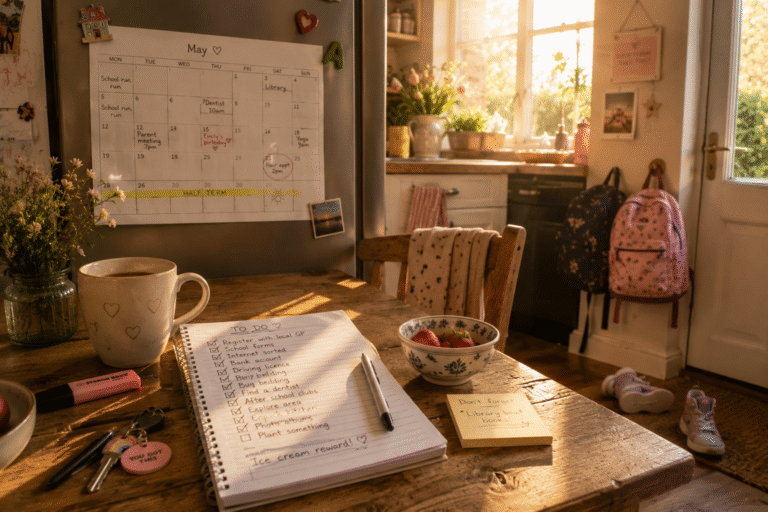
One thing that helped me was creating routines very early on. Especially for the things that absolutely had to get done. A visible family calendar saved my sanity more than once. School appointments, paperwork deadlines, doctor visits, sports clubs — if it was not written down, it simply stopped existing in my brain.
And honestly, when you move abroad with children, there are enough appointments to run a small government office.
For me personally, Sunday mornings became a lifeline. Before the girls woke up, I would sit quietly with coffee and write in my journal. I would look back over the previous week, then open the calendar and organise my thoughts for the next one. To-do lists. Worries. Plans. Tiny goals. Sometimes even little wishes for the week ahead.
It sounds simple, but those quiet moments helped me feel far less overwhelmed.
Humour helps too. Sometimes moving abroad feels less like a fresh start and more like surviving a strange obstacle course designed by bureaucracy and sleep deprivation.
Most importantly, give yourself time. Settling into a new country happens slowly, often in tiny little steps you barely notice at first.
Conclusion
Moving abroad with children is exciting, emotional, stressful, beautiful, and chaotic — often all in the same week.
Looking back now, I truly believe that good preparation takes a huge amount of pressure out of the move. Research helps. Organisation helps. Knowing how schools work, sorting paperwork early, and building small routines all make those first months feel far less overwhelming.
But even with all the planning in the world, there will still be surprises.
I honestly thought I had prepared well. At the end of the day we moved back to the place where I grew up. I already knew the culture, the language, and the area. Or at least I thought I did. Yet so many things had changed over the years, and many systems worked very differently from what I remembered.
Some things simply cannot be fully researched beforehand. You only learn them while living through them.
And that is probably the most important thing to remember: you do not have to do everything perfectly.
Some days will feel amazing. Other days will feel like you are starring in a strange comedy sketch about paperwork, school forms, and unanswered emails.
A good sense of humour really can save your sanity during moments like that.
Most importantly though, children are often far more resilient than we give them credit for. They do not need perfection. They need reassurance, honesty, stability, and the feeling that they are facing this adventure together with you.
Little by little, the unfamiliar starts feeling normal. And one day, without even noticing when it happened, your new place slowly starts feeling like home.